


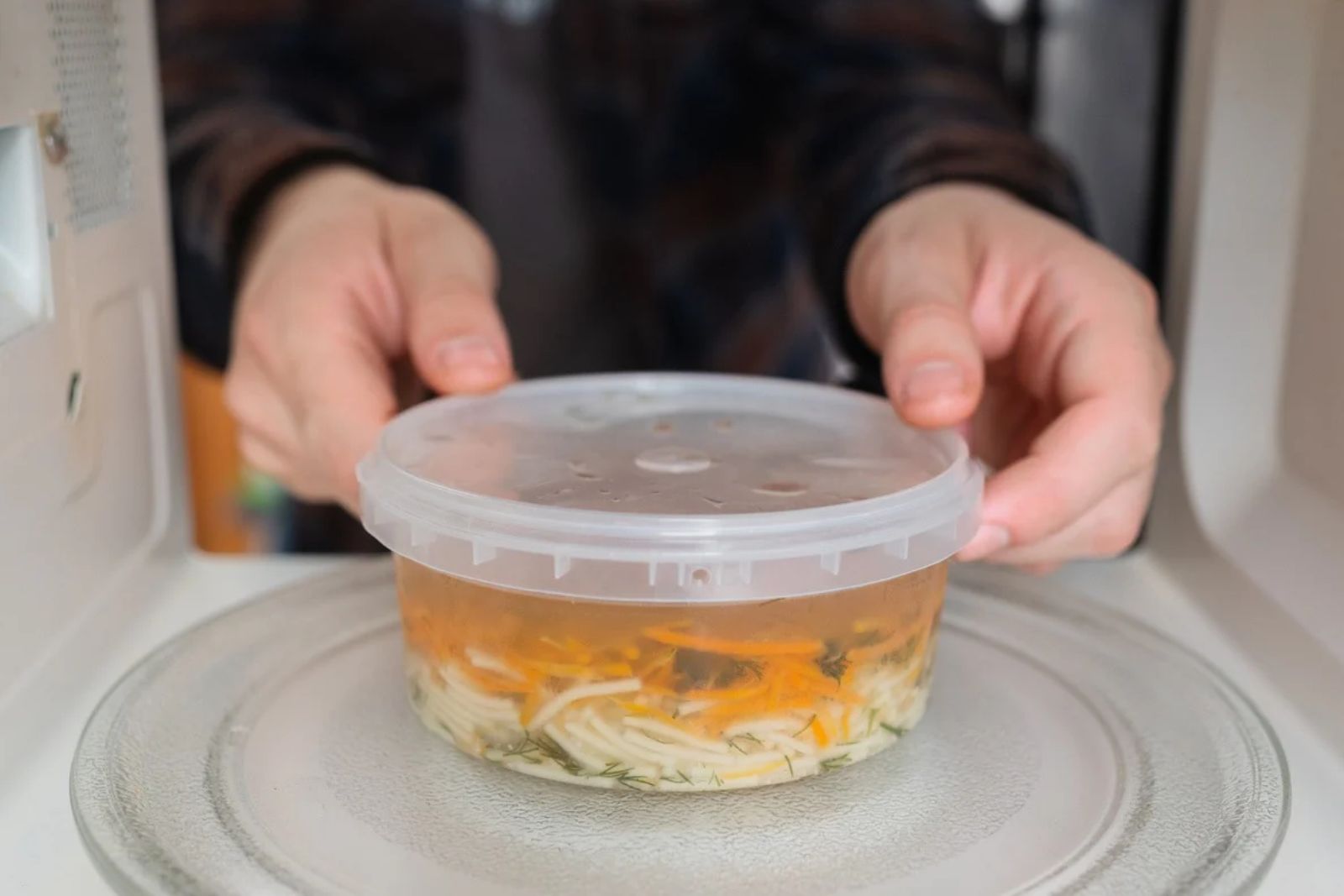
It's 12:30, the office microwave has a line, and last night's chili is still in the plastic tub you packed it in. You pop the lid and set 3 minutes. The edges of the container have gone a little cloudy, but they always look like that.
This is not your fault. Reheating food in the container you stored it in is how most of us were taught. But a team at the University of Nebraska-Lincoln put a version of that habit under the microscope, and the count is hard to forget: some containers released up to 2.11 billion nanoplastic particles from a single square centimeter of plastic in 3 minutes.
Why heat makes a plastic tub shed
The researchers bought two brands of polypropylene baby food containers at a popular US chain store. They filled them with water or a mild acid that stands in for acidic foods, then heated them at full power for 3 minutes in a 1,000-watt microwave. Their results, published in Environmental Science & Technology, showed that microwaving released more particles than any other scenario they tested.
Heat is the problem. According to the study, it speeds up hydrolysis, a reaction in which water breaks plastic chains apart, and it makes the plastic lose strength and expand unevenly. Acidic contents can add to the breakdown.
Across their tests, nanoplastics, particles smaller than a thousandth of a millimeter, outnumbered microplastics by roughly 1,000 to 1. Cold storage wasn't spotless either: experiments simulating months in the fridge or at room temperature also released particles, just fewer than the microwave.
The reheating routine, step by step
The fix is a transfer. USDA food safety guidance, summarized by Clemson Cooperative Extension, already points the same way.
- Move the food first. Spoon leftovers into a glass or ceramic dish without metallic trim before heating. Keep the plastic tub for the fridge, or swap it for glass over time.
- Keep cold-storage tubs out of the microwave. Margarine tubs, yogurt containers, whipped topping bowls and takeout containers aren't made for heating. They can warp or melt and let chemicals migrate into food.
- Test a mystery dish. Set the empty dish in the microwave next to a cup of water in a glass measuring cup and heat on high for 1 minute. If the dish stays cool, it's safe to use. If it turns warm or hot, keep it out of the microwave.
- Cover loosely. A lid set ajar, wax paper or parchment holds in moisture without plastic wrap touching the food. Stir halfway through.
- Finish at 165°F. Let the food stand a few minutes, then check it with a food thermometer: leftovers and casseroles should reach 165°F.
Plan B for the office: keep a ceramic bowl or plate in your desk drawer, and tip your lunch into it before you join the microwave line.
What the study can't tell you
This was a lab study on three baby food products, filled with water or acid rather than real chili or pasta. The numbers also varied a lot from one container to the next: in the microwave test, one tub released about 425,000 microplastics per square centimeter, the other about 4.22 million.
The team also exposed human embryonic kidney cells to the released particles in a lab dish. At the highest concentration, about 77% of the cells had died after 2 days. The authors note that this concentration was far higher than what the containers actually released, and the health effects of eating micro- and nanoplastics are still not known. A 2022 World Health Organization report recommended limiting exposure while research continues.
Lead author Kazi Albab Hussain started the project the year he became a father. "For my baby, I was unable to completely avoid the use of plastic," he said, so he avoided the situations that released the most particles instead.
If you warm baby food, transfer it to glass, stir well and test the temperature before feeding. Questions about a child's exposure are worth raising with your pediatrician.
Keep the tub for the fridge, give the microwave a glass dish, and stop at 165°F. That's the trick.

Leave a Reply