


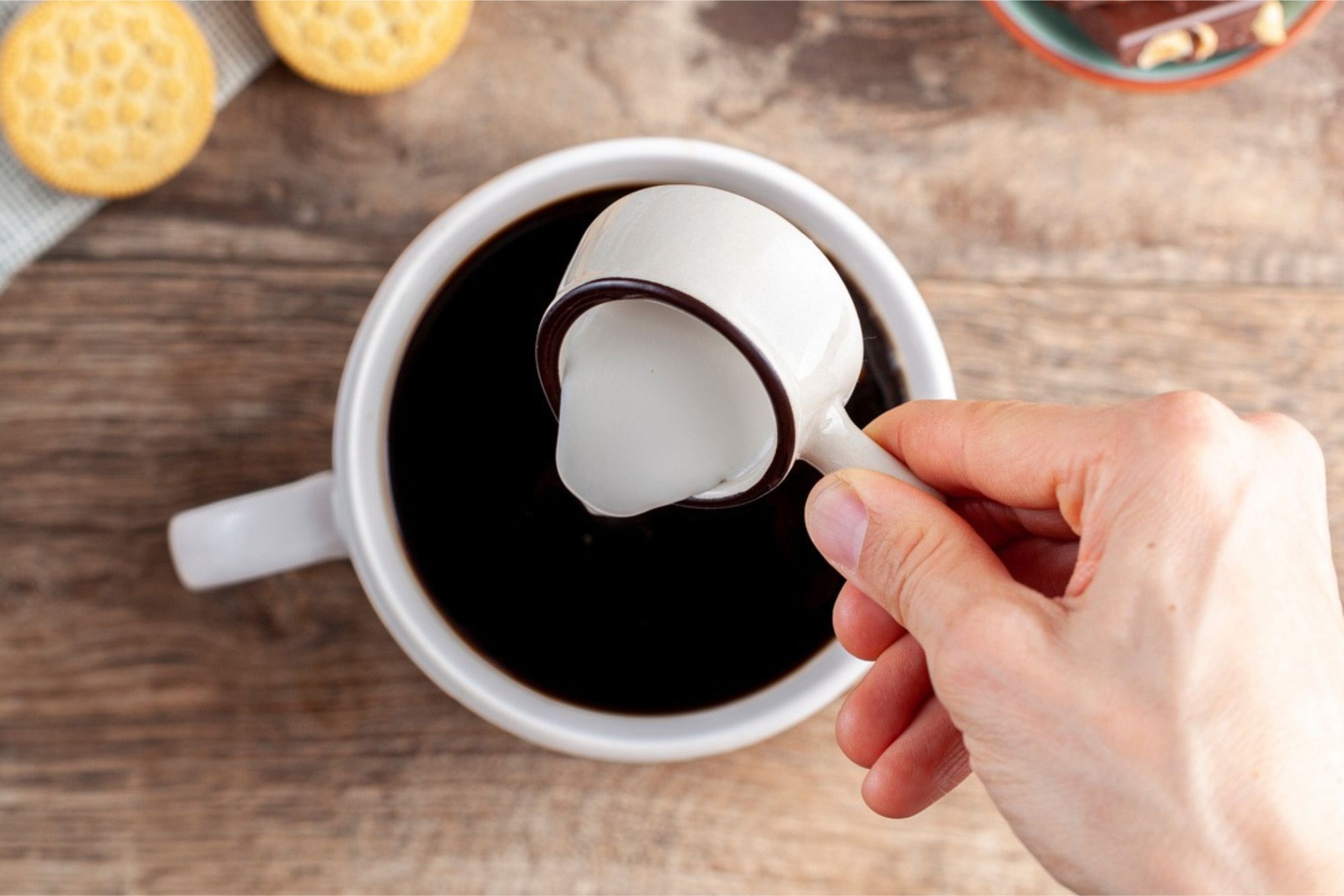
You switched to black coffee with "just a splash." No sugar packets, no syrup, nothing to feel guilty about. Then one morning you actually look at the mug: the coffee isn't brown anymore, it's tan, and the bottle of vanilla creamer in the fridge door is almost empty again, only a week after you opened it.
This is not your fault. Most of us keep an eye on the sugar bowl, not on the creamer. But a new analysis from Tufts University suggests that, nationwide, creamer has overtaken sugar.
Why the creamer adds up faster than sugar
Researchers at Tufts' Friedman School of Nutrition Science and Policy looked at national survey data (NHANES) from 2003 to 2018, covering about 30,000 U.S. adults who each reported two days of eating and drinking. The study was published in the Journal of the Academy of Nutrition and Dietetics.
The amount of coffee barely moved, staying around 13 ounces a day. What changed was what went into it. Calories from coffee rose from 43 to 60 a day, an increase of nearly 40%. By 2018, non-dairy creamer added an average of 18.5 calories a day, ahead of sugar at 16 and dairy milk at 11. In 2003, it added 7.71.
Part of the reason is what's in the bottle. As lead author Yongyi Pan put it, "Non-dairy creamers can be high in saturated fat, which is calorie dense." Many sweetened creamers bring sugar and fat in the same pour. The Center for Science in the Public Interest notes that most coffee creamers have about a teaspoon of added sugars in every tablespoon.
The swap, measured by the tablespoon
An official serving of liquid creamer is just 1 tablespoon, while many mugs hold at least 12 ounces. The fix starts with knowing your real pour.
- Measure once. CSPI's advice is simple: "Whip out a tablespoon and measure your typical pour." If your coffee looks more tan than brown, you may be using 3 tablespoons or more.
- Check the label per tablespoon. CSPI's top picks keep saturated fat to 1 gram or less per tablespoon, with 2 grams of added sugar or less.
- Dilute it with milk. Start with 1 tablespoon of your sweetened creamer, then top off the mug with dairy milk or unsweetened plant milk.
- Move toward milk. Dairy milk has half a gram of saturated fat or less per tablespoon and no added sugars. An earlier analysis of coffee drinkers, reported by the Tufts Health & Nutrition Letter, advised cutting sugar and syrups gradually and swapping cream for low-fat or skim milk.
- Keep the flavor, lose the sugar. Unsweetened plant-based creamers are an option: CSPI notes that most contain only a trivial amount of saturated fat per tablespoon.
Plan B if you miss the foam of a café drink: froth a little milk yourself with a milk frother instead of buying a sweetened cold foam.
What the study can't tell you
These are national averages, not your mug. Your own cup can land well above or below those figures, depending on what you pour and how much. The data also relies on people remembering what they ate and drank, which the researchers acknowledge can introduce errors, and its most recent year is 2018.
The study measured calories, not health outcomes, so it doesn't show that creamer itself makes anyone sick. It also found that adults who slept fewer hours or worked longer hours tended to drink more coffee.
One label detail matters for allergies: "non-dairy" doesn't always mean milk-free. A classic powdered non-dairy creamer lists sodium caseinate, a milk derivative, among its ingredients. If you have diabetes, a milk allergy or a heart condition, your doctor or a registered dietitian can help you choose what goes in your cup.
Measure the pour, check the tablespoon, top it off with milk. That's the trick

Leave a Reply