


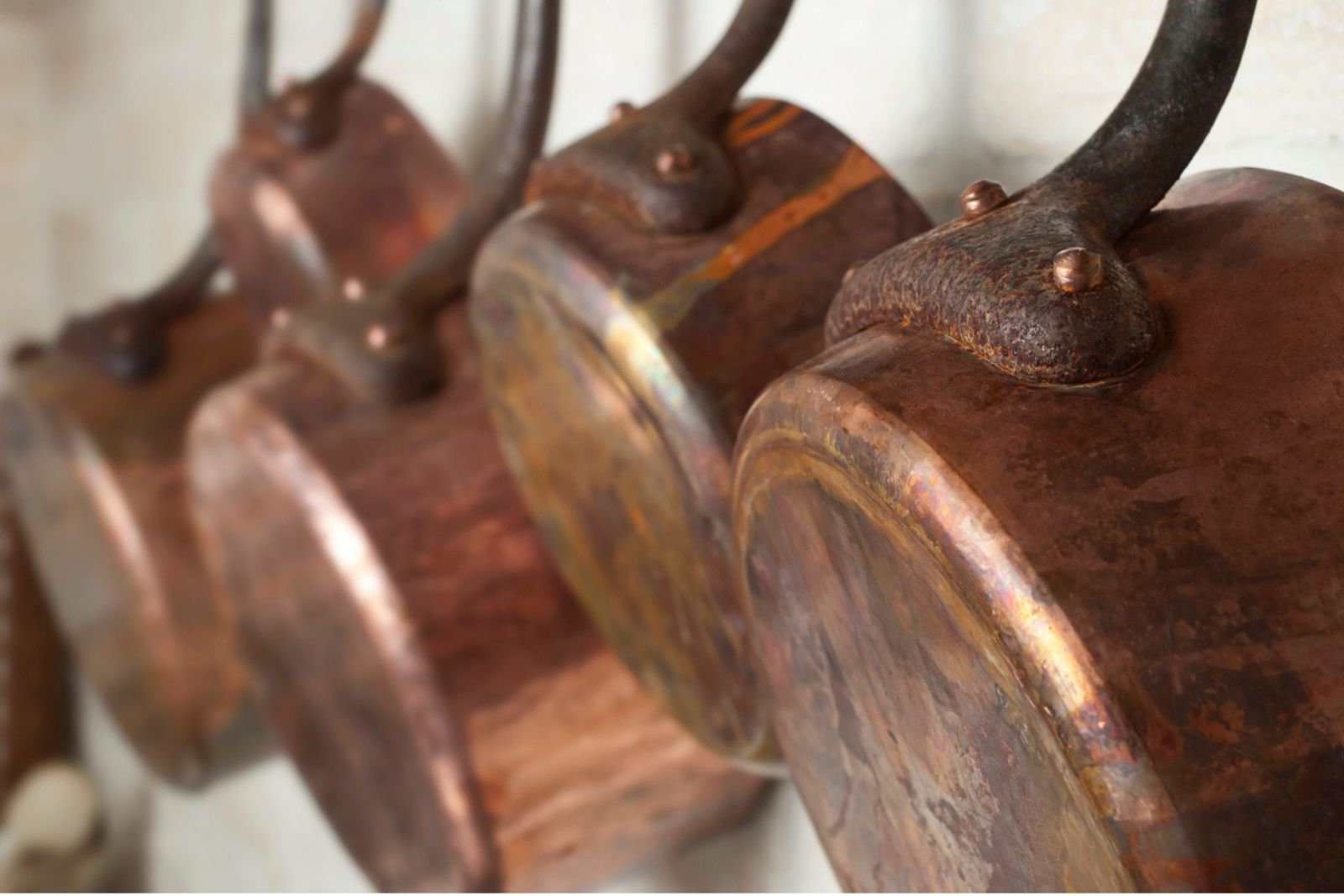
On the bottom shelf of a thrift store, between a scratched skillet and a stack of mismatched lids, sits a small stainless saucepan with a brown, blotchy copper bottom. It looks tired. You pick it up, put it back down, and go home with nothing.
This is not your fault. Tarnished copper doesn't look like much. But that pan may be vintage Revere Ware, and the stamp on its base can tell you whether it comes from the years collectors prize most.
What the copper bottom was built to do
Revere Ware comes from Revere Copper and Brass, a company that traces its roots to Paul Revere. According to the Smithsonian's Cooper Hewitt museum, company employee James M. Kennedy invented copper-clad cookware in 1938. Revere Ware debuted the following year at the Chicago Housewares Show.
The cooking surface is stainless steel, and the copper layer on the bottom spreads the heat. That layer is the catch. Revere Ware Parts, a replacement parts seller that has compiled the brand's history, says the copper cladding was cut by about half starting in 1968 to lower costs, which reduced how well the pans spread heat. You can't see the thickness from the outside, so the stamp is the clue.
Reading the stamp under the pan
- "Made Under Process Patent": This wording inside the circular logo with Paul Revere's profile marks pieces made from 1946 to 1968, the thicker copper years, according to Revere Ware Parts.
- "Pat. Pend.": This notation appears on the earliest clad pieces, made before the patent wording.
- "1801": The date in the mark refers to Paul Revere's first copper sheets, not a model number.
- A city name: The Riverside, Calif., and Clinton, Ill., plants identified their pieces in the hallmark. The original plant in Rome, N.Y., didn't add its name until 1974.
- No patent wording: A simpler logo with no mention of patents points to a piece made after 1968. Month and year codes were added in 1979.
Before you buy, set the pan on a flat shelf. It should sit without rocking, the handle should feel tight, and the copper should still be firmly attached to the base.
Plan B if your find turns out to be a later piece: it's still a stainless steel saucepan that can cook oatmeal, rice or a pot of beans. A 1987 Revere Ware use and care guide suggests medium heat until the food boils or sears, then low, and warns against letting a pan boil dry. If dinner does scorch, foil and a baking soda paste are a simple way of lifting burnt food off a pan.
Where the dating gets fuzzy
Hallmark dates are a guide, not a certificate. Revere Ware Parts notes in its photo guide that its timeline is pieced together from anecdotes, old advertisements and examined pieces, so some dates may be off. Even its own pages differ on exactly when the patent wording began.
Handles are worth a second look. The 1987 care guide rates that era's handles and knobs as oven safe up to 425°F, but older handles may not match that rating. Unless you know the limit for your piece, keep vintage Revere Ware on the stovetop.
Copper cleaner goes on the outside bottom only. The 1987 guide recommends rinsing in hot water and drying right away to prevent water spots, and soaking cooked-on food inside before washing.
Flip the pan, read the stamp, and look for the patent wording. That's the trick.

Leave a Reply