


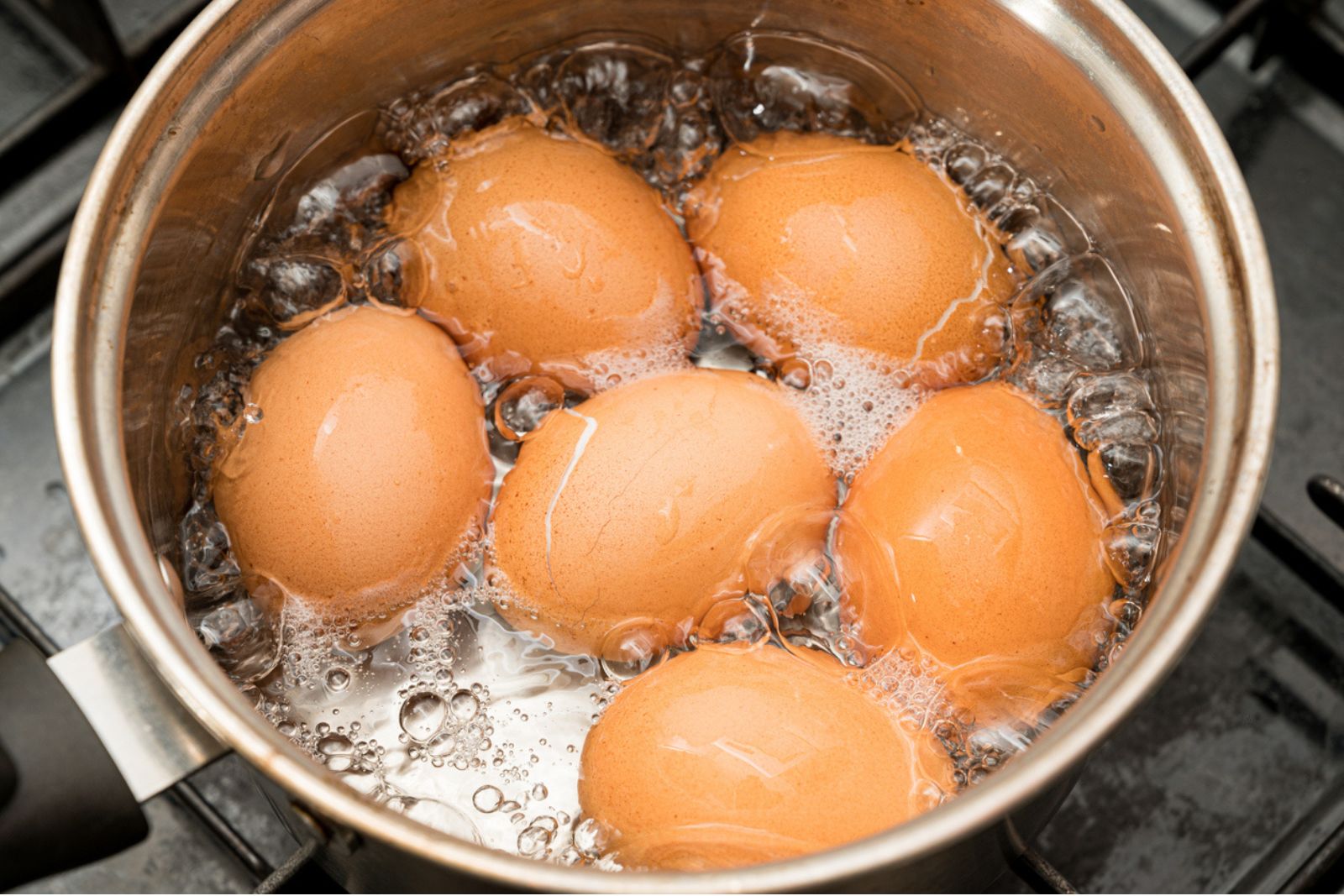
You hard-boiled a dozen eggs for deviled eggs. Now you're at the sink, picking off tiny bits of shell that refuse to let go. Chunks of white come away with them, and half the eggs end up looking cratered, not quite good enough for the platter.
This is not your fault. How easily an egg peels depends partly on its age and partly on how the heat hits it. Starting eggs in cold water is one of the most common habits, and it's not the easiest route. Steaming is.
Why the shell clings to the white
Under the shell, a thin membrane and a small pocket of air sit between the shell and the white. Food scientist Polly Burey of the University of Southern Queensland explains that in a fresh egg, that air cell is still small. As an egg ages, it slowly loses moisture and the air cell grows. In her words, "A bigger air cell makes it easier to start the peeling action." The white also becomes more alkaline with age, which helps.
Heat matters as much as age. Burey writes that exposure to higher temperatures right from the start of cooking makes it easier for the membrane to come away, and that a plunge in ice water helps the white shrink slightly from the shell. Some cooks believe steam also seeps through the shell and loosens the membrane, though that remains a theory.
A side-by-side test backs up the hot start. When Food & Wine's Adam Dolge compared six methods using large eggs straight from the refrigerator, steaming earned a perfect score and was the easiest to peel. Simmering from a cold start was the least consistent and the hardest to peel.
Steaming eggs, step by step
- Set up the pot. Add about 2 inches of water to a pot fitted with a steamer basket, making sure the water stays below the basket.
- Bring it to a boil. Heat the water to a full boil.
- Add the eggs. Use tongs or a spoon to set the eggs in the basket, cover the pot and lower the heat to keep a gentle simmer.
- Steam 12 minutes. Set a timer as soon as the lid goes on.
- Chill and peel. Move the eggs to a bowl of ice water for about 10 minutes, then peel.
Plan B if you don't own a steamer basket: lower the eggs into boiling water, then reduce to a simmer for 12 minutes. That method came in second in the same test. Add the eggs gently, since some cracked when dropped into the boiling water.
Peeled eggs are worth keeping on hand. Lively Table lists hard-boiled eggs among its high-protein snacks, since they need little more than salt and pepper.
Keeping a week of eggs safe
Very fresh eggs, like those straight from a backyard flock, can still be stubborn even when steamed, since their air cell hasn't had time to grow. Buying eggs a few days ahead of time can help.
Refrigerate cooked eggs within 2 hours. FoodSafety.gov says hard-cooked eggs keep for 1 week in the refrigerator and shouldn't be frozen.
Steam burns fast, so lift the lid away from you when you add or remove the eggs. And if anyone at the table has an egg allergy, keep the platter clearly labeled.
Start them hot in steam, give them 12 minutes, and chill them in ice water. That's the trick.

Leave a Reply