


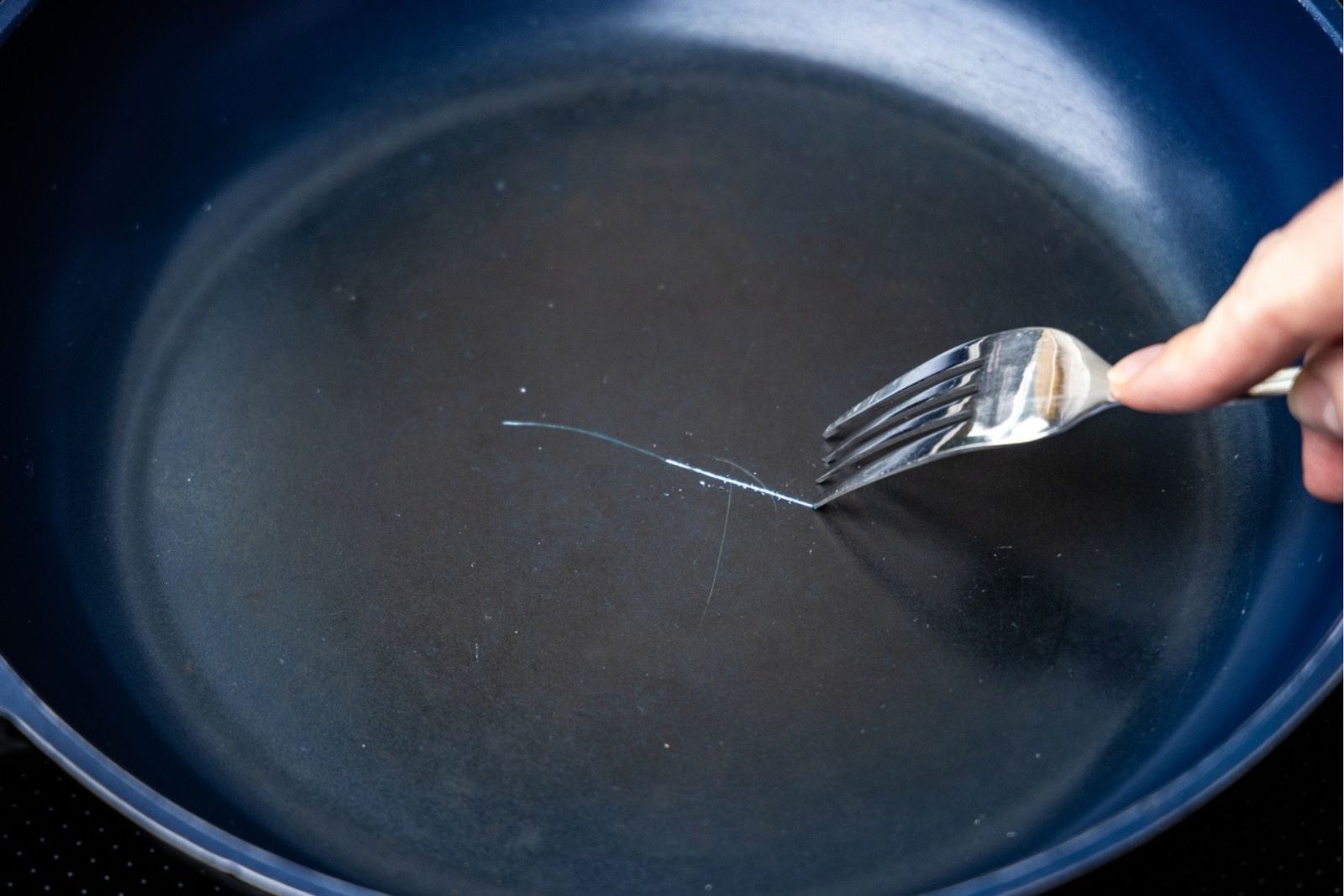
Your favorite egg pan has been with you for years. Lately, the surface has a few thin silver lines where the fork scraped it, and the eggs don't slide out the way they used to. You add a little more butter and keep going.
This is not your fault. Nonstick pans don't come with an expiration date, and small scratches look cosmetic. But researchers in Australia put a damaged coating under a special microscope and counted what came off it.
What the researchers counted on a damaged pan
A team from Flinders University and the University of Newcastle used Raman imaging, a method that identifies materials by how they scatter light, to look at Teflon-coated cookware. According to Flinders University, just one surface crack could release about 9,100 plastic particles, and a broken coating could release about 2.3 million microplastics and nanoplastics.
Teflon belongs to the large family of chemicals known as PFAS. Researcher Cheng Fang said that because PFAS is a big concern, these particles might be a health concern and need investigating. The study was published in Science of the Total Environment in 2022.
The takeaway from the lead researcher, Youhong Tang, was practical: people must be careful about selecting and using cooking utensils.
Keeping your nonstick pan in one piece
- Swap the metal tools. Use wooden or silicone spatulas and spoons instead of forks, whisks and metal turners.
- Clean it gently. Wash by hand with a soft sponge. Skip steel wool and abrasive scrubbers.
- Stack with care. Put a paper towel or a pan protector between stacked pans so the bottom of one doesn't scratch the coating of another.
- Check the surface. Look for cracks, chips or flaking every few months. Those are the kinds of damage the researchers measured.
- Retire it when it's broken. A coating that's flaking or visibly cracked is a good reason to replace the pan.
Plan B if you'd rather skip coatings altogether: cast iron or stainless steel. Cast iron works for more than eggs: Lively Table bakes its healthy skillet cornbread in one.
Where the evidence stops short
The study counted particles released from damaged coatings. It didn't measure how many end up in your food or what they do in the body. Fang himself noted that little is known about these emerging contaminants, and Tang called for more research on the risks.
The FDA says the manufacturing process for nonstick pots and pans vaporizes off virtually all the smaller PFAS molecules, and that studies show negligible amounts of PFAS in the coating can migrate to food.
One more piece of history: PFOA, a PFAS chemical once used in making nonstick coatings, was the target of a voluntary EPA program that asked major manufacturers to work toward eliminating it from emissions and products by 2015. The EPA reports that all companies met the program's goals.
Wooden tools, a soft sponge, and a new pan once the coating breaks. That's the trick.

Leave a Reply